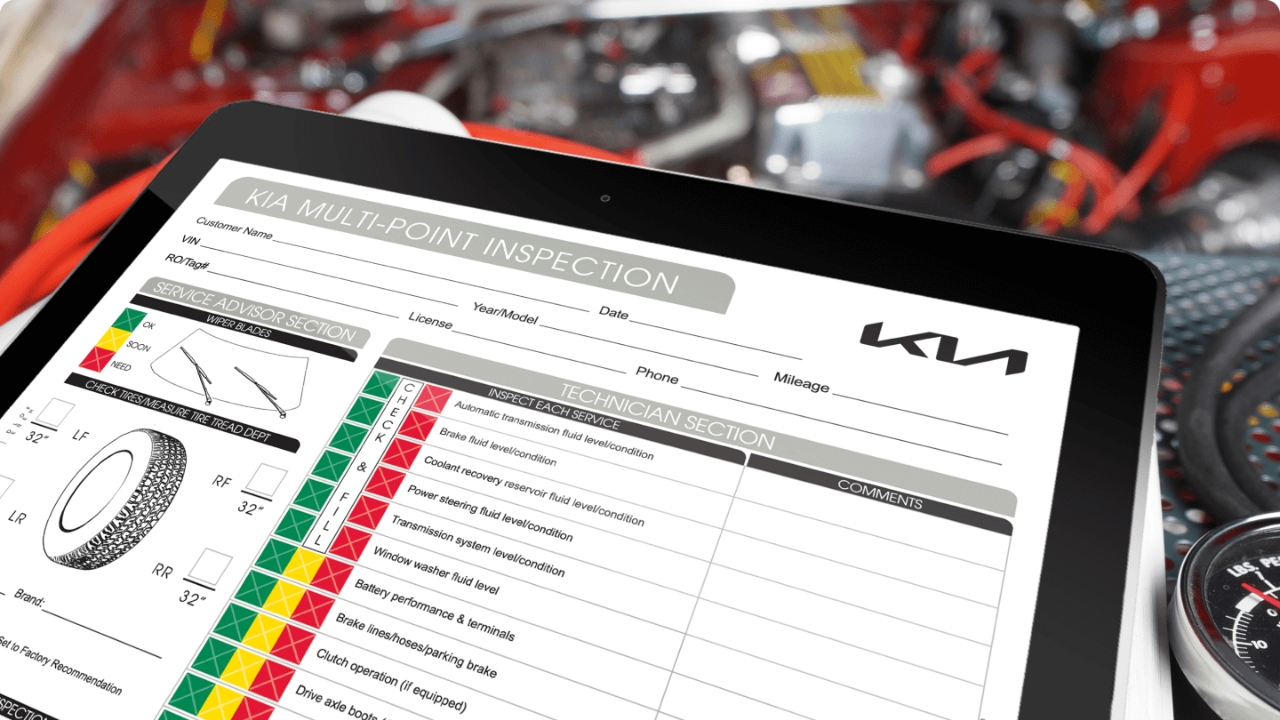
Tire Service in Charleston, SC at Kia Country of Charleston

Four Patches of Rubber Decide Whether the Car Stops in Time
Everything your vehicle does, from turning to braking to holding a lane in a downpour, happens through contact patches roughly the size of your hand. Tread depth, inflation, and wear pattern decide how much of that grip you actually have. The tire department at Kia Country of Charleston serves drivers throughout Charleston, SC, and works on all makes and models rather than the Kia lineup alone. Every tire concern starts with measurement: tread depth at multiple points, pressure at all four corners, and a look at wear patterns that reveal what the rest of the vehicle is doing. That approach catches the alignment or suspension issue behind a worn tire instead of selling you a new set that wears out the same way.
Reading the Numbers Stamped on the Sidewall
The code molded into every sidewall is a specification sheet, not decoration. A marking like 235/55R19 gives section width in millimeters, aspect ratio as a percentage of that width, and rim diameter in inches. Beside it sit the load index and speed rating, which describe how much weight the tire can carry and how much sustained heat it can handle.
Tread depth is measured in thirty seconds of an inch. New passenger tires typically start around ten or eleven thirty seconds, and legal minimum in most states is two. Wet traction falls off well before that point, which is why replacement usually gets recommended in the four to five thirty seconds range rather than at the wear bars.
- Tread compound and pattern, which set grip in wet, dry, and cold conditions
- Steel belts and body plies that give the tire its shape under load
- Sidewall flex, which affects both ride comfort and steering response
- Bead and inner liner, the parts that hold air and seal against the rim
- DOT date code, a four digit stamp giving the week and year of manufacture
Heat is what actually ages a tire in service. Underinflation increases sidewall flex, flex generates heat, and heat breaks down the bond between rubber and steel belts. That is the mechanism behind most highway tread separations, and it starts with a pressure loss nobody noticed.
Rubber also ages chemically whether the vehicle moves or not. A tire that still looks presentable at eight or nine years old can have hardened compound and fine sidewall cracking that reduce grip well below what the tread depth suggests. Date codes are worth checking on any vehicle that sits for long stretches.
What Uneven Wear Is Telling You
Wear patterns are diagnostic evidence. Both outer shoulders worn while the center still has tread means the tire has been running underinflated, since a soft tire rides on its edges. Center wear with healthy shoulders is the reverse, a sign of chronic overinflation crowning the tread.
One shoulder worn and the other untouched points at camber, a suspension geometry issue rather than an air pressure one. Feathering, where each tread block has a sharp edge on one side and a rounded edge on the other, almost always traces back to a toe setting that has drifted out of specification.
- A vibration through the steering wheel that appears in a narrow speed band
- Recurring low pressure warnings from a single wheel position
- Visible bulges, blisters, or cuts through the sidewall
- Cracking between tread blocks or along the sidewall shoulder
- Any tire that reaches four thirty seconds of remaining tread
Pressure warnings deserve more attention than they usually get around here. Air is a gas, and pressure drops roughly one pound per square inch for every ten degree drop in ambient temperature, so a cool snap can trigger a light on tires that are otherwise fine. A tire that needs air every week has a different problem, usually a slow puncture, a corroded rim bead seat, or a leaking valve stem.
Catching a wear pattern early is what saves money. A toe misalignment found at ten thousand miles costs an alignment, while the same misalignment found at thirty thousand costs an alignment plus a set of tires. Scheduling a check when you first notice a pull or a new noise keeps the bill in the first category.
Tire Work Handled at Our Charleston Service Center
Rotations, repairs, balancing, and replacement are all available for all makes and models.
Rotation and Pressure Service
Rotation moves tires between positions so wear distributes evenly across the set, which matters most on front wheel drive vehicles where the front tires do the steering and most of the braking. The pattern used depends on drivetrain, tire type, and whether the sizes are staggered front to rear. Pressures get set cold to the door placard specification, not to the maximum number printed on the sidewall. Technicians also reset the tire pressure monitoring system and verify each sensor reports correctly. Wear depth at every position is recorded so you can see how the set is progressing over time.
Puncture Repair and Leak Diagnosis
A nail in the tread area can often be repaired properly, and a proper repair means dismounting the tire and installing a combination patch and plug from the inside. Plugs installed from the outside without removing the tire are a temporary measure, not a permanent fix. Punctures in the sidewall or shoulder cannot be repaired safely at any price, because those areas flex constantly and no patch will hold. When a tire loses air with no visible object, the wheel gets submerged to find bead leaks, valve stem failures, or corrosion on the rim seat. You will get a clear answer on whether the tire can be saved before anything is quoted.
Mounting, Balancing, and New Tires
New tires are mounted on equipment designed to protect both the wheel finish and the tire bead, then balanced to eliminate the vibration that shows up at highway speed. Balancing corrects weight distribution around the assembly, and a wheel that will not balance usually has a bent rim or a tire with internal belt movement. Replacement recommendations come with tread measurements attached so you can see exactly where each tire stands. Options across multiple brands and price points are laid out, along with the load index and speed rating your vehicle requires. An alignment check is recommended with any new set so the tires do not start wearing incorrectly on day one.
Measuring Tread Before Recommending Anything
A tire recommendation should come with numbers behind it. Every tire gets measured at the inner edge, center, and outer edge, because a single reading in the middle can hide a shoulder that is nearly bald. Those measurements go on your paperwork so the advice is verifiable rather than a matter of opinion.
A specific example shows why this matters. A driver comes in with a vibration at highway speed and expects to buy four new tires. Measurement shows plenty of tread but a heavy cupped pattern on the two front tires, and a lift inspection finds a leaking front strut driving the wear. Replacing the tires alone would have handed that customer the same vibration a few months later, on a brand new set.
- Tread depth measured at three points across each tire and written on the estimate
- Wear patterns traced back to a cause before replacement gets recommended
- Repairability of a puncture judged by location and inspection, not by convenience
- You approve pricing and options before any tire is dismounted
Once new tires are installed, torque is set with a wrench to the manufacturer specification rather than an impact gun, and a retorque is recommended after the first fifty to one hundred miles as the wheel seats. Pressures are set cold, the monitoring system is relearned, and the vehicle gets a short road test to confirm the vibration is gone.
Tire service covers all makes and models, and most rotations, balances, and repairs are completed the same day with a scheduled appointment. Replacement sets are usually available quickly, though a less common size may take an extra day to arrive.
Tire Fitment Across the Kia Range
Fitment varies more within a model line than most owners expect. A Sportage on seventeen inch wheels and the same model on nineteens use entirely different tire sizes, load indexes, and pressure specifications, and a Telluride carries a significantly higher load rating than a Forte or Soul. The correct size is confirmed against the door placard and the VIN, since previous owners sometimes install a size the vehicle was never built to use.
Electric models bring their own requirements. An EV6 or Niro EV weighs more than a comparable gasoline vehicle and often runs tires with reinforced construction and low rolling resistance compound, so substituting a standard passenger tire changes both range and load capacity. Timing is honest here: rotations and balances typically take under an hour with an appointment, a set of four takes longer, and a special order size may need a day or two to arrive.
- Size, load index, and speed rating verified against the door placard and VIN
- Tire pressure monitoring sensors tested, serviced, and relearned during any tire work
- Road force and dynamic balancing available for vibrations that standard balancing will not resolve
Find Kia Country of Charleston in Charleston, SC
Where Our Tire Customers Come From
Between summer heat, standing water on low lying roads, and the debris that turns up in construction zones, tires around here work hard. Drivers schedule tire service with us from across the region, including:
- North Charleston, SC
- Summerville, SC
- James Island, SC
- Mount Pleasant, SC
- Goose Creek, SC
- Ladson, SC
- West Ashley, SC
- Moncks Corner, SC
Bring the vehicle in for a tread and pressure check, and you will leave knowing exactly how much life each tire has left.
Common Questions About Tires
Drivers ask these at the counter constantly, whatever badge is on the grille.
Q: How often should tires be rotated?
Q: Can a nail in my tire be repaired?
Q: Do I have to replace all four tires at once?
Q: What is included in a tire inspection here?
Q: Will you service tires on a vehicle from another brand?
Not sure whether that vibration or slow leak is worth a trip in? Call the service desk, describe what the vehicle is doing, and an advisor will tell you whether it needs immediate attention.
Tire questions are quick to answer over the phone.
Reserve a Tire Appointment
A tire that is losing air slowly today can go flat on a bridge tomorrow, usually at the least convenient possible moment. Slow leaks and low tread do not improve on their own.
Measurements come before recommendations, and pricing is presented before anything gets dismounted. If your tires have life left, you will hear that instead of a sales pitch.
Book an appointment online, call the service desk, or drive in and let a technician take a look. Rotations and repairs move quickly, and you will leave with tread numbers in hand.
Service Specials

Buy 3 Tires, Get One for
PLUS Road Hazard Protection

Spend and Save


30,000 Mile Service

60,000 Mile Service