Wheel Alignment Service in Charleston, SC
A Fraction of a Degree Off Can Cost You a Set of Tires
Alignment angles are measured in tenths of a degree, and a setting outside that narrow window scrubs rubber off your tires every mile you drive. The steering wheel sitting slightly crooked on a straight road is the visible clue, though plenty of misalignment produces no steering symptom at all. Kia Country of Charleston performs alignments for drivers across Charleston, SC on all makes and models, from compact sedans to full size trucks. Every alignment starts with a measurement of the current angles and a suspension inspection, because worn tie rod ends or bushings make an adjustment pointless. The printout you leave with shows where each angle started and where it ended up.
Toe, Camber, and Caster in Plain Language
Three primary angles describe how each wheel sits relative to the vehicle and the road. Toe is the direction the wheels point when viewed from above, camber is how far the top of the wheel tilts inward or outward when viewed from the front, and caster is the forward or rearward tilt of the steering axis viewed from the side.
Toe does the most damage when it drifts. A wheel pointed even slightly inward or outward gets dragged sideways as the vehicle moves forward, and that sideways scrubbing shaves tread away in a hurry. Camber wears one shoulder of the tire faster than the other, while caster mostly affects steering feel and straight line stability without wearing tires directly.
- Toe, the angle most responsible for rapid and uneven tread wear
- Camber, which determines how evenly the tire loads across its width
- Caster, which controls steering effort, stability, and self centering
- Thrust angle, describing whether the rear axle points straight ahead
- Steering angle sensor position, which driver assistance systems depend on
Thrust angle is the one most people have never heard of and the one that explains a lot of complaints. If the rear wheels are not pointed straight down the vehicle centerline, the front has to steer slightly off center to compensate, which is why a car can track straight with a crooked steering wheel. Correcting that requires measuring all four wheels, not just the front pair.
Alignment and balancing get confused constantly, and they solve different problems. Balancing corrects weight distribution around a spinning wheel and cures vibration, while alignment corrects the angles at which wheels meet the road and cures pulling and uneven wear. A vehicle can need one, the other, or both.
What Knocks Alignment Out in the First Place
Potholes and hard curb strikes are the usual culprits. A single serious impact can move a control arm within its bushing tolerance or bend a component outright, and the vehicle may drive normally enough that nothing feels wrong for weeks.
Wear is the slower path to the same place. Rubber bushings soften and compress over years, ball joints and tie rod ends develop play, and springs sag enough to change ride height. Since alignment angles are partly a function of ride height, a settled suspension shifts camber and toe without anything being damaged.
- The vehicle drifts toward one side on a flat, straight road
- The steering wheel sits off center while the car tracks straight
- Tread wear that is heavier on one shoulder than the other
- Feathered tread blocks with a sharp edge on one side
- Steering that feels vague or fails to self center after a turn
A pull is not always an alignment problem, which is worth knowing before you pay for one. Uneven tire pressures, a tire with internal belt movement, a dragging brake caliper, and even a crowned road surface all produce a pull. Measuring the angles before adjusting anything is what separates those causes and keeps you from buying the wrong repair.
The cost argument for acting early is straightforward. An alignment is a modest expense, while a set of tires is not, and a toe setting left uncorrected can ruin good tires within a few thousand miles. Getting angles measured after a hard impact, after suspension work, or whenever you install new tires protects the money you have already spent.
Alignment Services Available at Our Service Center
Four wheel alignment, pull diagnosis, and post repair corrections are performed on all makes and models.
Four Wheel Alignment
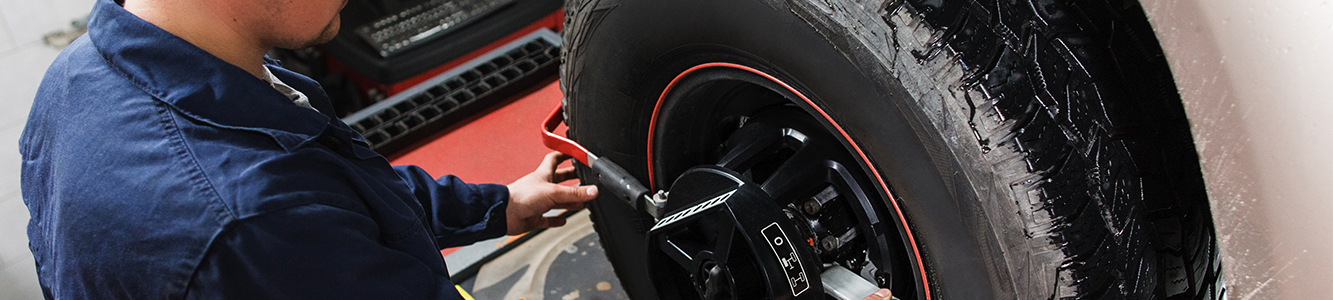
The vehicle is set on the alignment rack with targets mounted to each wheel, and current readings for toe, camber, caster, and thrust angle are captured before anything is touched. Ride height and tire pressures are corrected first, since both influence the measurements. Adjustments are made to bring every adjustable angle within the manufacturer specification for your vehicle. Where an angle cannot be brought into range, the technician identifies which worn or damaged component is preventing it. You receive a printout showing before and after readings for all four wheels.
Pull and Wear Diagnosis
When a vehicle pulls or wears tires unevenly, the first job is proving what is causing it. A technician measures alignment angles, checks pressures and tire condition, and inspects for a dragging brake or a tire with internal belt shift. A road test on a level surface confirms the direction and severity of the pull. Cross swapping front tires is a fast way to determine whether a tire rather than the geometry is responsible. The recommendation that follows names the actual cause instead of defaulting to an alignment.
Post Repair and Sensor Calibration
Suspension and steering repairs change alignment angles, so tie rod, control arm, and strut replacements are followed by a measurement and correction. The steering angle sensor is reset so the stability control system knows where straight ahead actually is. On vehicles equipped with lane keeping assist or forward facing cameras, alignment changes can require a calibration of those systems to keep them accurate. Technicians confirm which calibrations your vehicle needs by VIN rather than assuming. The vehicle gets road tested afterward to verify the steering wheel sits centered and the car tracks straight.
Inspection Comes Before the Adjustment
An alignment performed on a worn suspension does not hold. Before a single adjustment is made, the vehicle goes on a lift and a technician checks tie rod ends, ball joints, control arm bushings, wheel bearings, and strut mounts for play, because any of those will let the angles wander right back out.
Consider a common scenario. A customer comes in for an alignment because the vehicle pulls to the right and the front tires are wearing on the inside edges. The rack shows toe out of specification, but the lift inspection also finds a tie rod end with noticeable play. Adjusting the toe without replacing that part would have produced a perfect printout and a vehicle back out of alignment within a few hundred miles.
- Suspension and steering components inspected for play before any adjustment
- Tire pressures corrected and ride height measured as part of the setup
- Worn parts identified and quoted separately, with your approval before replacement
- Angles that cannot be brought into specification explained rather than left unmentioned
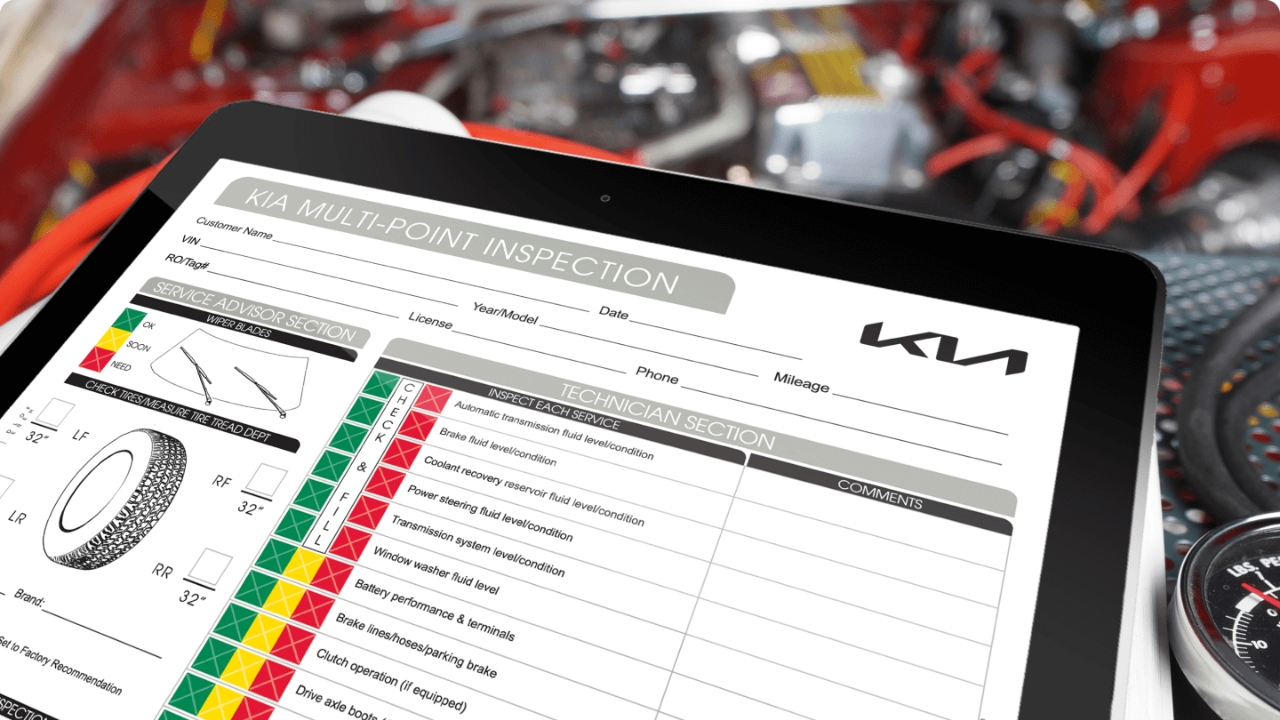
Every alignment finishes with a printed report showing before and after readings for all four wheels against the factory specification, so you can see exactly what changed. A road test on level pavement confirms the steering wheel is centered and the vehicle tracks straight without correction. If it still pulls, the vehicle returns to the rack instead of going home.
Alignment service is available for all makes and models, and most alignments are completed the same day with a scheduled appointment. Jobs that turn up worn components take longer, since the parts have to be replaced before the final adjustment can be set.
Alignment Specifications Across the Kia Lineup
Specifications vary by model, trim, and even by wheel and tire package. A Sportage or Sorento with a larger wheel package carries different target angles than the base configuration, and a Telluride has different front geometry than a Forte or Soul. Adjustability also differs, since some models offer camber and caster adjustment at the front while others provide toe adjustment only, which means an out of range camber reading indicates a bent or worn part rather than a setting somebody neglected.
Driver assistance systems add a step that did not exist on older vehicles. Lane keeping assist and forward collision warning rely on cameras and radar aimed relative to the vehicle thrust line, so alignment changes on equipped models can require a calibration afterward. Timing stays realistic here: a straightforward four wheel alignment is usually completed the same day with an appointment, while alignments requiring calibration or parts replacement need additional time that the advisor will explain up front.
- Factory specifications pulled by VIN, including trim and wheel package variations
- Steering angle sensor reset performed as part of the alignment procedure
- Driver assistance calibration handled where the vehicle equipment requires it
Find Kia Country of Charleston in Charleston, SC
Alignment Customers from Across the Lowcountry
Construction zones, patched pavement, and the occasional unforgiving curb keep the alignment rack busy. Drivers schedule alignments here from communities throughout the region, including:
- James Island, SC
- Mount Pleasant, SC
- North Charleston, SC
- Johns Island, SC
- West Ashley, SC
- Summerville, SC
- Daniel Island, SC
- Hanahan, SC
If the steering wheel is off center or the tires are wearing unevenly, put the vehicle on the rack and find out where the angles actually sit.
What Drivers Ask About Alignment
The questions below come up with owners of every make and model, and the answers apply across the board.
Q: How often does a vehicle need an alignment?
Q: My car does not pull, so is the alignment fine?
Q: Is a front end alignment enough, or do I need all four wheels?
Q: What does an alignment at your shop include?
Q: Can you align a vehicle that is not a Kia?
If you are unsure whether an alignment is what your vehicle needs, call the service desk and describe the symptom. An advisor can often tell from the tire wear pattern and how the car behaves whether the rack is the right next step.
Measuring first beats guessing every time.
Put Your Vehicle on the Alignment Rack
Misalignment does its damage quietly. Tread disappears from one edge of a tire while everything feels normal, and by the time the wear is obvious the tires are already finished.
Inspection comes before adjustment here, and worn parts get identified rather than adjusted around. Nothing is replaced without your approval, and you leave with a printout proving where the angles ended up.
Reserve a spot online, call the service desk, or stop in and describe what the vehicle is doing. A technician will measure the angles and give you the numbers.
Service Specials

Buy 3 Tires, Get One for
PLUS Road Hazard Protection

Spend and Save


30,000 Mile Service

60,000 Mile Service